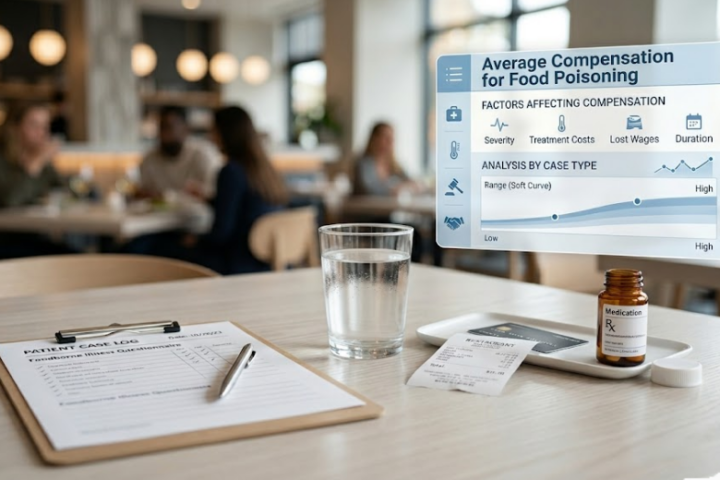
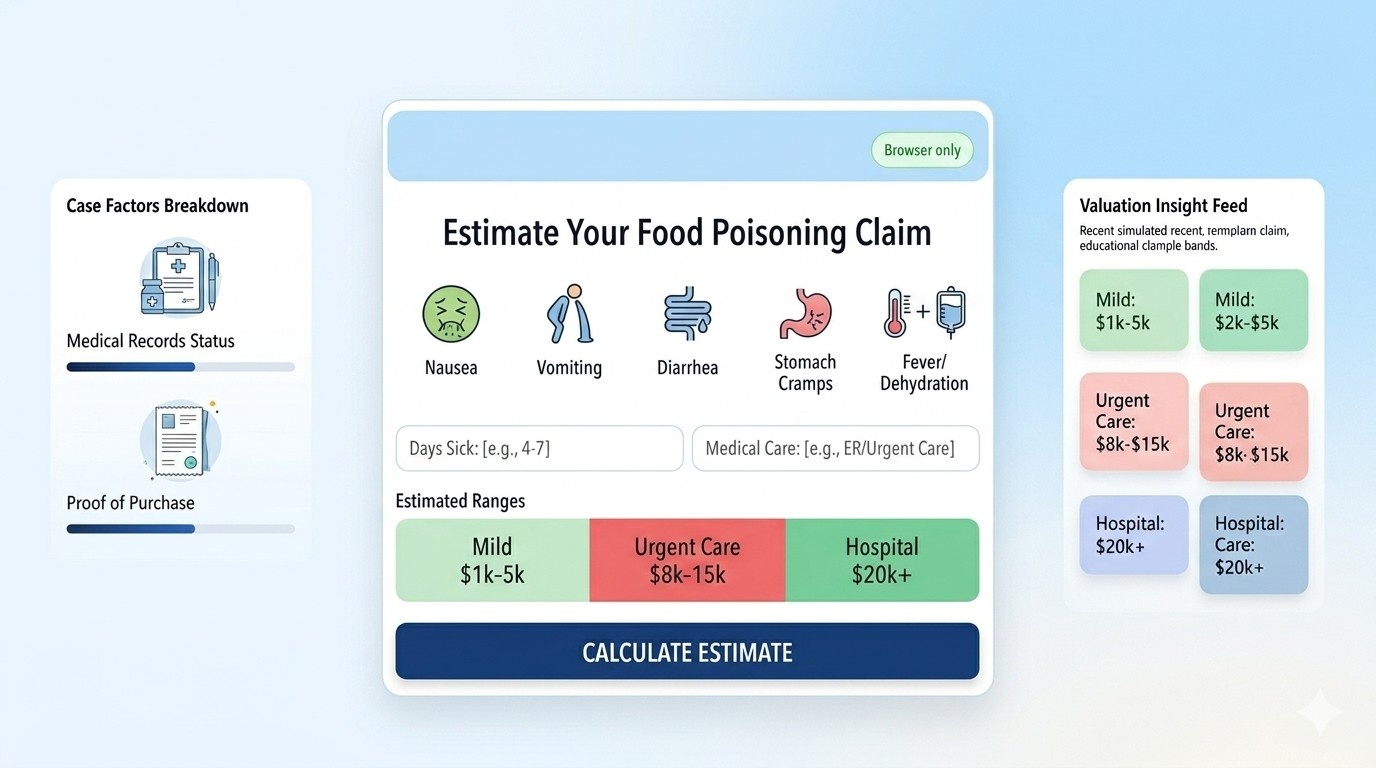
How much is a food poisoning claim worth? The honest answer is that most cases do not have one fixed payout. A food poisoning claim can be worth a few thousand dollars when symptoms are short, treatment is minimal, and proof is weak. It can move much higher when there is urgent care or ER treatment, dehydration, lab confirmation, missed work, multiple people getting sick from the same food, or a clearly traceable restaurant or product source.
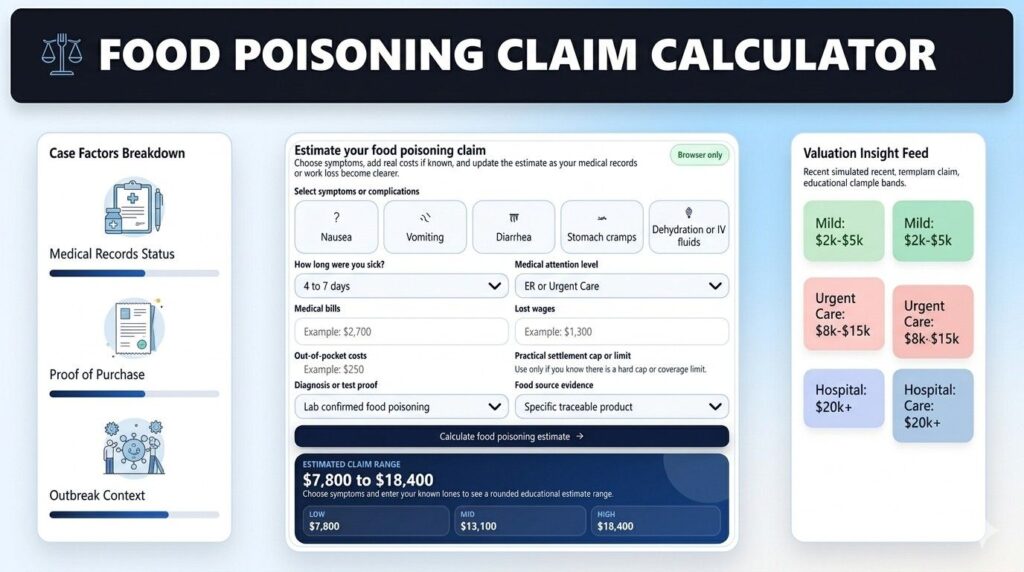
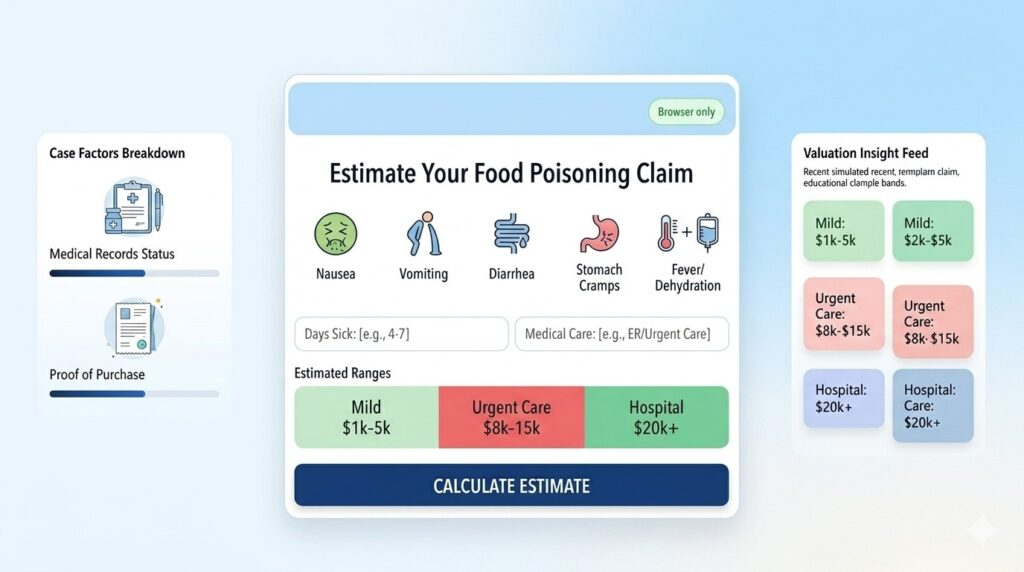
If you want a fast estimate first, use the food poisoning claim calculator. This guide explains why the result can move up or down, what proof matters most, and why a restaurant food poisoning claim is usually stronger when you have both medical records and source evidence.
Updated April 2026: this guide uses current CDC, FDA, and NIDDK public-health and medical sources. The settlement ranges below are educational estimate bands, not guaranteed compensation.
On this page:
- What is the average food poisoning claim range?
- What makes a food poisoning claim worth more?
- How a restaurant food poisoning claim is usually valued
- What proof matters most?
- When does a food poisoning claim have limited value?
- When should you use the calculator?
- Sources and method
- FAQs
What is the average food poisoning claim range?
There is no official national public database that publishes one true average food poisoning settlement amount for every case. That is why trustworthy content should not pretend there is one universal payout number. Instead, the best way to think about claim value is by severity, treatment level, and proof.
| Claim profile | Typical pattern | Educational claim band | Why the range changes |
|---|---|---|---|
| Mild short illness | Home recovery, no diagnosis, little or no missed work | Often under $2,500 | Minimal economic damages and weak proof of source |
| Clinic or telehealth documented illness | Medication, several missed shifts, likely source identified | $2,500 to $10,000 | Medical records and wage loss make the claim stronger |
| Urgent care or ER case | Vomiting, diarrhea, dehydration, IV fluids, longer recovery | $7,500 to $25,000 | Higher medical cost and stronger pain-and-suffering case |
| Hospitalization or outbreak-linked case | Admission, stronger diagnosis proof, public-health context | $20,000 to $75,000+ | Severity and causation evidence both improve |
| Complication or high-risk case | Child, pregnancy, older adult, kidney risk, or serious complication | $50,000 to $250,000+ | Longer recovery and higher medical seriousness push value up |
These are educational ranges only. Real results still depend on proof of source, medical documentation, state negligence law, and whether the other side accepts that the food caused the illness.
What makes a food poisoning claim worth more?
The biggest value drivers in a food poisoning claim are usually simple to spot. They are the same things that make any injury file easier to prove and harder to dismiss.
- Medical treatment: urgent care, ER records, IV fluids, prescriptions, and follow-up care usually increase claim value.
- Missed work: if you missed hourly shifts, used PTO, lost freelance work, or missed self-employed income, the claim becomes stronger and easier to quantify.
- Diagnosis strength: a doctor diagnosis helps, and a stool test or other lab confirmation can help even more.
- Traceable source: restaurant receipts, delivery-app records, grocery receipts, product photos, or labels can make the claim far stronger.
- Multiple sick people: if more than one person became ill after the same meal or product, that often makes causation much easier to explain.
- Severity and duration: longer illness, dehydration, or more serious complications usually push the value higher.
This is exactly why a claim based on a rough memory of “I think that meal made me sick” behaves very differently from a claim backed by an urgent care note, a same-day receipt, and several missed shifts.
How a restaurant food poisoning claim is usually valued
A restaurant food poisoning claim is often the most common version people ask about. The value usually depends on two questions: how serious was the illness, and how clearly can you connect the illness to the restaurant?
If you saw a doctor, kept the receipt, and have a short time gap between the meal and symptoms, the claim starts from a much stronger position. If several people at the same table became ill, that strengthens it further. If there is also an FDA investigation, local health department issue, or contaminated-product recall tied to the same meal or ingredient, the broader context can become much more favorable.
But restaurant claims are also where people often overestimate their case. If you have no medical record, no receipt, no lab support, and ate from several places over the same period, the claim can be difficult to prove even if you were genuinely sick.
For a working range that includes these variables, start with the food poisoning claim calculator, then cross-check wage loss through the lost wages calculator.
What proof matters most?
In food poisoning cases, proof matters more than people expect. A short illness with strong proof can sometimes be worth more than a longer illness with weak proof.
The strongest supporting evidence usually includes:
- doctor, urgent care, ER, or telehealth records
- stool test or lab confirmation if ordered
- restaurant receipt, delivery receipt, or grocery purchase record
- photos of the food, packaging, product label, or leftovers
- texts or statements from other people who got sick from the same meal
- missed work proof, cancelled jobs, or business-loss records
- recall, outbreak, or public-health notice that matches the timeline
The CDC and FDA both show why this topic is still serious. The CDC’s current foodborne illness burden estimates show that major pathogens still cause millions of illnesses and tens of thousands of hospitalizations in the United States, while the FDA continues to track active outbreak investigations. Those sources do not prove an individual claim by themselves, but they show why medical documentation and source evidence are so important.
When does a food poisoning claim have limited value?
Some claims stay small because the illness was short, there was no real treatment, there was no missed work, and the food source is uncertain. That does not mean the illness was not real. It just means the claim may have limited economic damages and weaker proof.
Examples of lower-value claim patterns often include:
- one day of symptoms with no medical attention
- no missed work or measurable expenses
- several possible food sources over the same time period
- no receipt, no packaging, and no one else becoming sick
- late reporting that makes the timeline harder to verify
That is why it is better to think in terms of practical claim strength than just asking for an “average settlement amount.” A calculator page is useful because it forces that practical review.
When should you use the calculator?
Use the calculator as soon as you have the first reliable facts: symptom pattern, treatment level, medical bills, missed work, and your best understanding of the source. Then update the estimate if you get lab confirmation, additional care, or stronger food-source evidence later.
The best workflow is:
- Run the food poisoning claim calculator first.
- Use the lost wages calculator if the illness cost you real income.
- Calculate your pain and suffering if the illness was severe, prolonged, or highly disruptive.
- Review the methodology page so you understand how the range is being built.
- If the claim broadens into a larger negligence case, compare it with the personal injury settlement calculator.
This is the safest way to use a calculator: as an educational estimate tool, not as a guarantee.
Sources and method
This article uses current public-health and medical sources rather than made-up average payout claims. The CDC foodborne illness burden page reports current estimate data for major foodborne pathogens. The CDC symptoms page explains which symptom patterns are more serious. The FDA outbreak investigations page shows that active foodborne illness investigations continue in 2026. The NIDDK food poisoning overview explains dehydration risk and common complications.
The claim bands in this article combine those medical and public-health sources with standard personal-injury factors such as treatment level, missed income, source proof, symptom severity, and duration. That is why the article explains realistic ranges instead of pretending there is one official food poisoning settlement number.
FAQs
Is there a true average food poisoning settlement amount?
No official national public average exists for every case. Claim value depends on severity, treatment, work loss, and proof of source, so ranges are more honest than one average number.
Can I make a claim if I only went to urgent care?
Yes. Urgent care records can be very helpful. Many valid claims involve clinic treatment, prescriptions, missed work, and clear source evidence without a hospital admission.
Does it help if other people got sick too?
Usually, yes. When several people become sick after the same meal or product, the source becomes easier to explain and the claim usually becomes stronger.
Should I include gig work or business loss?
Yes. If you lost freelance jobs, missed deliveries, cancelled appointments, or saw reduced self-employed income, that belongs in the claim value analysis.
Can a food poisoning claim include pain and suffering?
Yes. Severe nausea, vomiting, diarrhea, weakness, dehydration, embarrassment, travel disruption, and recovery burden can support non-economic damages, not just reimbursement of bills.
What is the best next step if I want a real estimate?
Use the food poisoning claim calculator first, then update the estimate as your treatment, diagnosis proof, and wage-loss records become clearer.
Bottom line
The best answer to how much is a food poisoning claim worth is this: it depends on treatment, missed work, diagnosis strength, source proof, and how severe the illness really was. Short, poorly documented cases often stay low. Strongly documented ER or hospital cases with clear source evidence can move much higher.
If you want a realistic starting range, use the food poisoning claim calculator and then compare it with your medical records, work loss, and proof of source before reacting to any settlement offer.