The average medical malpractice settlement is not one simple national number. Malpractice payouts vary by injury severity, future medical care, disability, wrongful death exposure, state damages caps, and how clearly negligence caused the harm. If you are searching for medical malpractice settlement amounts, the safest answer is to use a range-based estimate, not a fake one-line average.
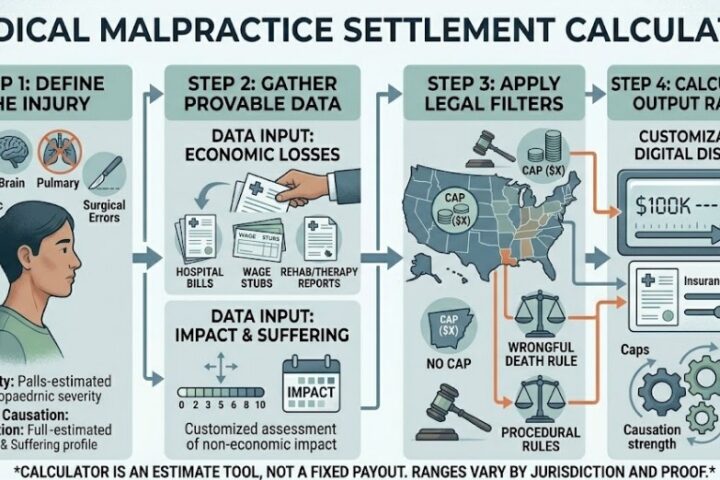
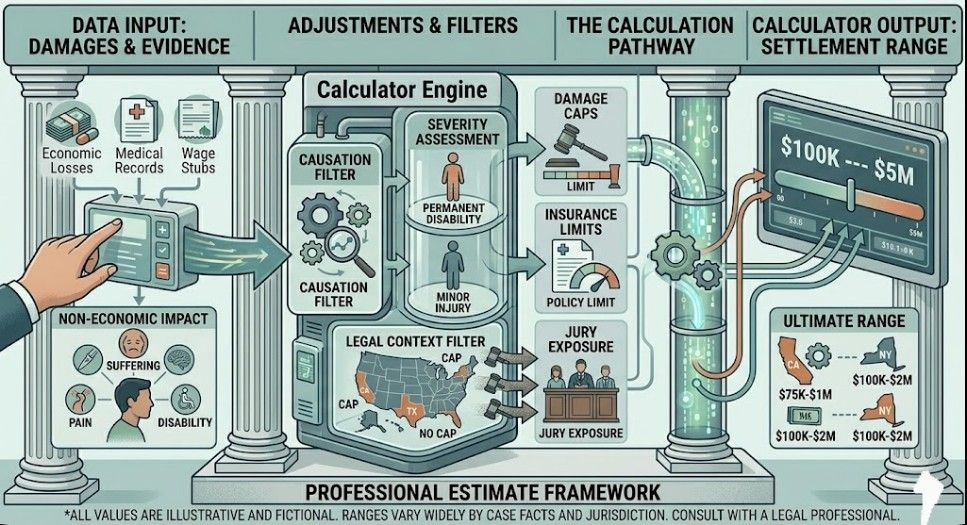
That is exactly why the medical malpractice settlement calculator matters. It helps translate malpractice losses into a realistic planning range. This article gives the context behind that estimate: what “average” can and cannot mean, why malpractice settlement by type matters more than a single national figure, and why state law can change the practical value of the same injury.
Updated April 2026: this guide uses current National Practitioner Data Bank and National Conference of State Legislatures sources. The estimate bands below are educational, not guaranteed payouts.
On this page:
- What does “average medical malpractice settlement” really mean?
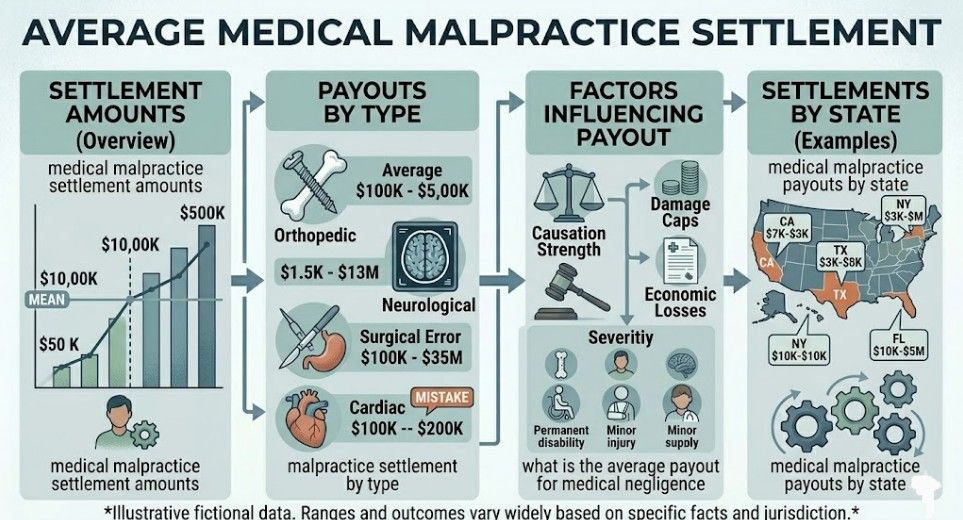
- Medical malpractice settlement amounts by case type
- Why “average by specialty” is harder than it sounds
- Medical malpractice payouts by state
- What raises or lowers a malpractice settlement?
- When to use the malpractice settlement calculator
- Sources and method
- FAQs
What does “average medical malpractice settlement” really mean?
Most people use the word average because they want a quick benchmark. The problem is that medical malpractice is one of the least “average” injury categories on the internet. A temporary medication mistake that resolves quickly is not in the same universe as a birth injury, missed cancer diagnosis, paralysis case, or wrongful death claim. Grouping all those outcomes into one number can be misleading.
The best public source for broad malpractice payment context is the National Practitioner Data Bank Public Use File, which was updated in February 2026 and includes disclosable reports through December 31, 2025. That dataset is useful for national trend analysis, but it does not create a fair “your case equals this number” shortcut.
So the right way to interpret the average medical malpractice settlement is this:
- It is a broad context term, not a precise prediction.
- Higher-value cases usually involve permanent injury, major future care, or death.
- Mid-range cases usually involve stronger treatment records, measurable work loss, or meaningful long-term impact.
- Lower-value cases usually involve shorter recovery, lower economic damages, and less severe permanent effect.
Medical malpractice settlement amounts by case type
If you want realistic guidance, malpractice settlement by type is much more useful than one generic national number.
| Malpractice case type | Common value drivers | Educational settlement band | Why the range moves |
|---|---|---|---|
| Diagnosis-related error | Delayed diagnosis, missed cancer, worsened prognosis, added treatment burden | $75,000 to $500,000+ | Future care and causation proof drive the value. |
| Surgery-related malpractice | Wrong-site injury, avoidable complications, nerve damage, repeat surgery | $100,000 to $750,000+ | Revision procedures and disability raise value. |
| Medication-related malpractice | Wrong drug, wrong dose, allergic reaction | $40,000 to $300,000+ | Severity varies widely. |
| Obstetrics or birth injury | Neurological injury, lifelong care | $500,000 to multi-million+ | Very high future-care exposure. |
| Psychiatric malpractice | Failure to protect, worsening condition | $50,000 to $250,000+ | Proof issues affect value. |
| Wrongful death | Death-related loss | $250,000 to multi-million+ | State law matters heavily. |
Medical malpractice payouts by state
Yes, payouts vary significantly due to state law and damages caps.
What raises or lowers a malpractice settlement?
- Severity of harm
- Future care needs
- Causation strength
- Economic damages
- State law
When to use the malpractice settlement calculator
- Use calculator
- Estimate wages
- Estimate suffering
- Compare wrongful death
- Review methodology
FAQs
Is there one true average?
No, it depends on multiple factors.
Can birth injury cases be higher?
Yes, significantly higher.
Do caps reduce settlements?
Yes.
Bottom line
Average is only context. Real value depends on facts.