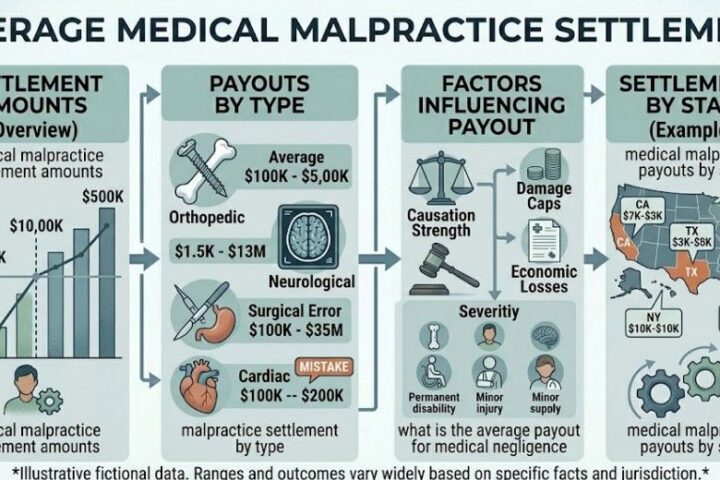
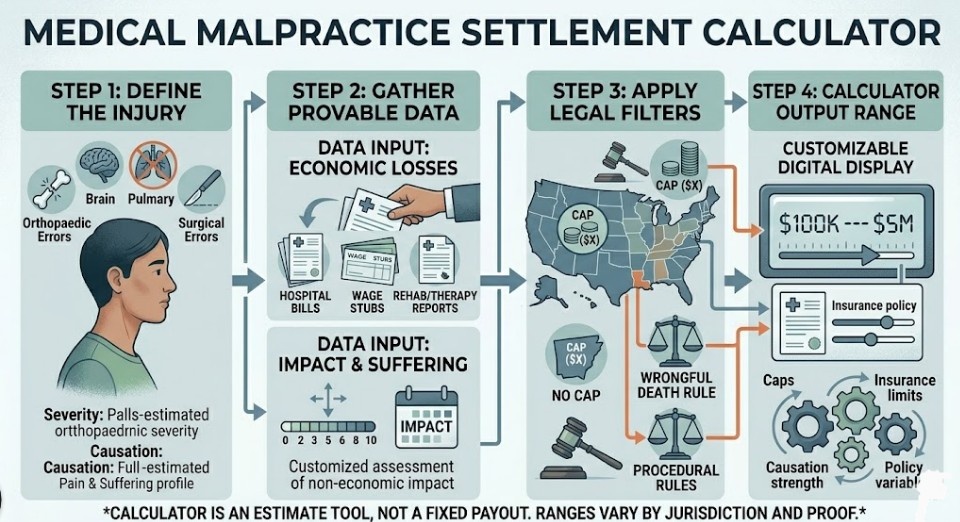
Medical malpractice settlements are calculated by adding provable economic losses, estimating non-economic damages, and then adjusting for liability strength, causation, state law, and practical insurance limits. That is the clean answer. If you are searching for a medical malpractice settlement calculator, the right way to use one is not as a magic payout machine, but as a structured estimate tool that helps you understand what actually drives malpractice value.
Medical negligence cases are different from simpler injury claims because they usually require more proof, more expert review, and more attention to state rules. A malpractice case can involve future medical care, reduced earning capacity, disability, wrongful death losses, and state damage caps. That is why the same injury can produce a very different settlement in different states or with different evidence. If you want the tool first, start with the medical malpractice settlement calculator. This guide explains how the numbers behind that estimate actually work.
Updated April 2026: this article uses current National Practitioner Data Bank and NCSL sources for malpractice reporting and state-law context. The ranges and examples below are educational, not guaranteed results.
On this page:
- How are medical malpractice settlements calculated?
- What damages go into a malpractice settlement?
- What is the average payout for medical negligence?
- Do medical malpractice payouts vary by state?
- What is the maximum payout for medical negligence?
- Why expert review and causation change the value
- When to use a medical malpractice settlement calculator
- Sources and method
- FAQs
How are medical malpractice settlements calculated?
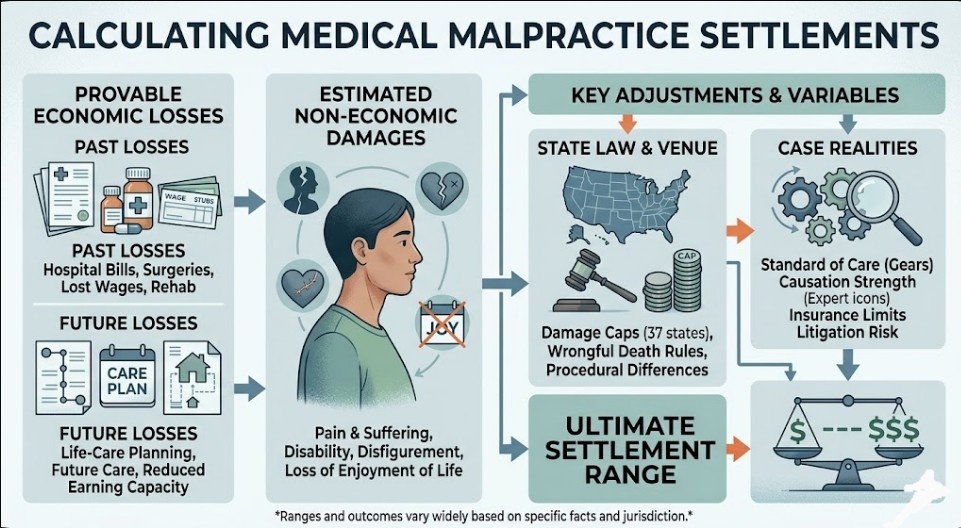
The core structure is simple even if the case is not. A malpractice settlement usually starts with economic damages, then adds non-economic damages, then gets adjusted by case-specific realities.
The basic malpractice valuation framework looks like this:
- Past losses: hospital bills, surgeries, medication, rehab, follow-up care, lost wages, and direct out-of-pocket expenses.
- Future losses: additional treatment, life-care planning, home modifications, long-term assistance, and reduced earning capacity.
- Non-economic damages: pain and suffering, disability, disfigurement, loss of normal life, emotional distress, and long-term quality-of-life loss.
- Liability and causation review: how clearly the provider breached the standard of care and how clearly that breach caused the injury.
- State-law adjustment: damage caps, wrongful-death rules, procedural rules, and venue tendencies can move the practical number up or down.
- Insurance and settlement reality: policy limits, institutional defendants, litigation risk, and jury exposure affect the final range.
That is why malpractice claims do not behave like simple “medical bills times a multiplier” cases. A calculator can still be useful, but it has to reflect future care, wage loss, pain and suffering, and state-law constraints. If you want a planning estimate built around those ideas, use the medical malpractice settlement calculator, then compare the output with the methodology page.
What damages go into a malpractice settlement?
Most malpractice settlements are built from two core buckets of damages.
| Damage category | What it includes | Why it matters |
|---|---|---|
| Economic damages | Past and future medical treatment, therapy, medication, assistive care, lost wages, reduced earning capacity, transportation, and out-of-pocket loss | These are the most document-driven parts of the claim and often set the baseline for the whole case. |
| Non-economic damages | Pain and suffering, emotional distress, disability, loss of function, scarring, disfigurement, and loss of enjoyment of life | These often become the largest disputed part of a serious malpractice case. |
| Wrongful death damages | Death-related financial losses, family damages where permitted, and related claim-specific losses | These can change dramatically by state and by the relationship of survivors to the deceased. |
| Punitive damages | Rare, usually tied to especially egregious conduct | These are not normal in ordinary malpractice settlement valuation and often depend heavily on state law. |
What is the average payout for medical negligence?
People search this question because they want a shortcut. The problem is that there is no one national average that fairly predicts an individual malpractice case. Medical malpractice claims vary too widely by injury severity, specialty, state law, future care cost, and expert support.
The best public source for national malpractice payment context is the National Practitioner Data Bank public use file, which was updated in February 2026 to include disclosable reports through December 31, 2025. That file is useful for broad statistical research, but it does not give one simple number you can safely plug into your own case and call it accurate.
A better approach is to think in ranges:
- Lower-value malpractice claims often involve temporary injury, shorter recovery, and smaller future-loss exposure.
- Mid-range claims usually involve stronger treatment records, longer disruption, or measurable future care needs.
- High-value claims often involve permanent disability, birth injury, surgical error, major neurological harm, or death.
Do medical malpractice payouts vary by state?
Yes, sometimes dramatically. State law can change the value of the same underlying injury because damages, procedure, and venue rules are not uniform.
The National Conference of State Legislatures reports that, as of its February 17, 2025 update, 37 states plus several territories have enacted some form of limit or cap on at least one type of damages in medical liability cases.
What is the maximum payout for medical negligence?
There is no single national maximum payout for medical negligence. In some catastrophic cases, payouts can reach seven figures or more when the injury is permanent, the future care need is enormous, and liability is strong.
Why expert review and causation change the value
Malpractice cases are usually harder to prove than ordinary injury claims because they depend on more than just showing a bad outcome.
- Standard of care: was the provider’s conduct outside accepted medical practice?
- Causation: did that breach actually create the injury?
- Future impact: what ongoing consequences exist?
When to use a medical malpractice settlement calculator
- Start with the calculator.
- Estimate wage loss.
- Estimate pain and suffering.
- Compare wrongful death if applicable.
- Review methodology.
FAQs
Can a medical malpractice settlement include future medical costs?
Yes. Future care is often a major part of serious cases.
Why do similar cases settle differently?
Because causation, evidence, and law differ.
Do caps reduce settlements?
Yes, especially non-economic damages.
Bottom line
Medical malpractice settlements are built from provable losses, future impact, pain and suffering, causation strength, and state-law limits.