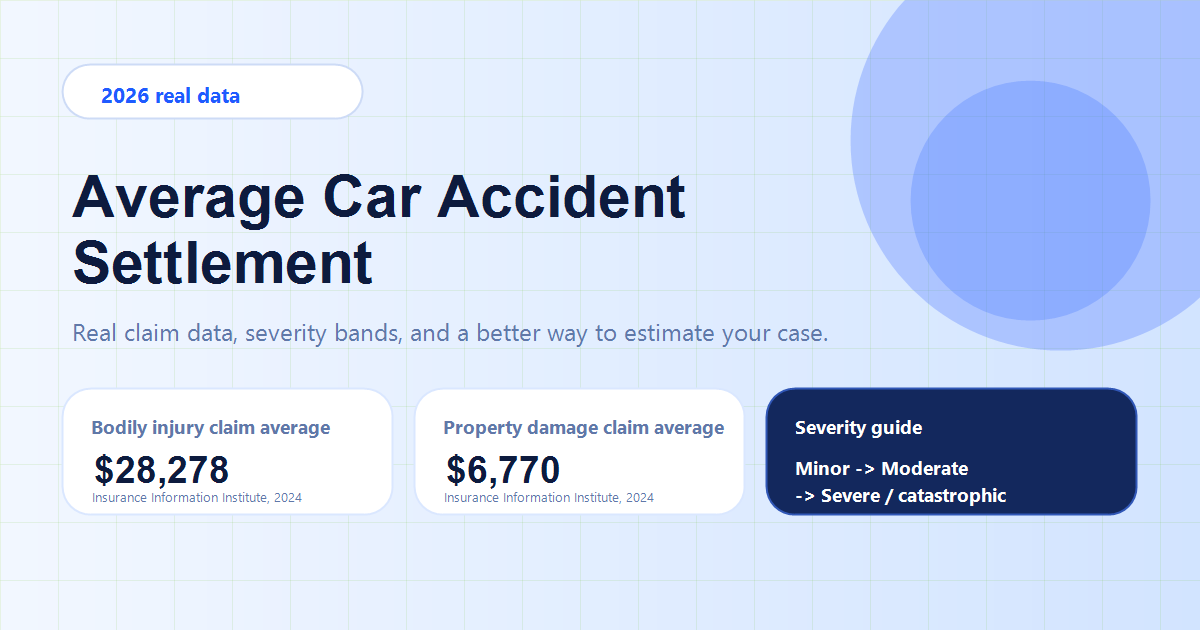
The average car accident settlement is not one fixed national number. In 2024, the Insurance Information Institute reported an average bodily injury liability claim of $28,278 and an average property damage liability claim of $6,770 for private passenger auto insurance. Those numbers help set expectations, but they do not guarantee your result. A small rear-end crash with short-term treatment can settle far below that average, while a severe crash with surgery, lost income, or permanent limits can climb well above it.
If you want a practical answer, the typical car accident settlement amount rises and falls with five things: injury severity, medical treatment, lost wages, fault, and policy limits. That is why two crashes that happened on the same day can produce very different payouts. The table below shows how public data lines up with realistic settlement bands.
Updated April 2026: this guide uses current public claim data from the Insurance Information Institute and current injury-cost data from the National Safety Council. The settlement bands below are educational estimate ranges, not guaranteed payouts.
Average car accident settlement by injury severity
| Claim profile | Public data signal | Educational settlement band | Why the range moves |
|---|---|---|---|
| Property damage only | III average property damage liability claim: $6,770; NSC property-damage-only cost: $6,600 | Under $10,000 in many cases | Repair cost, rental cost, and whether any injury claim exists |
| Minor soft-tissue injury | III average bodily injury liability claim: $28,278; NSC possible injury economic cost: $28,000 | $8,000 to $30,000 | Urgent care, physical therapy, missed work, and clear fault proof |
| Moderate injury | NSC evident injury economic cost: $45,000 | $25,000 to $75,000 | Imaging, injections, longer treatment, wage loss, and pain duration |
| Severe or disabling injury | NSC disabling injury economic cost: $174,000 | $75,000 to $250,000+ | Surgery, fracture, permanent limits, future care, and insurance limits |
| Catastrophic injury or death | NSC death economic cost: $2.05 million | $250,000 to seven figures | Life-care costs, lost earning capacity, liability disputes, and available coverage |
These bands are educational estimates, not a published government settlement chart. They combine current public claim data with common settlement drivers used in real injury negotiations.
How these estimate bands were built
- Property damage and bodily injury benchmarks come from current III claim-severity data.
- Severity tiers use current NSC motor-vehicle injury-cost data.
- Settlement bands widen or narrow based on treatment length, work loss, fault, and policy limits.
- The ranges are designed to help users compare claim types, not replace legal or insurance review.
What is the average car accident settlement?
If you mean the average paid bodily injury liability claim, the best current public benchmark is $28,278 in 2024, according to the Insurance Information Institute using ISO data. If you mean the average property damage payout, the same 2024 public benchmark is $6,770. Those are real industry figures, but they are still incomplete for one important reason: a car accident settlement often includes far more than vehicle damage alone.
A full bodily injury settlement can include medical bills, future treatment, wage loss, reduced earning capacity, and non-economic damages such as pain and suffering. It can also shrink if fault is shared or if the at-fault driver carries a low policy limit. That is why the phrase average car accident payout is useful for orientation, but not enough to value an individual claim.
Typical car accident settlement amount by injury severity
The fastest way to understand the typical car accident settlement amount is to match the crash to the injury level.
Minor injuries often involve soft-tissue pain, brief physical therapy, and little or no missed work. These cases can still settle well if the crash was clear and the records are clean, but they do not usually behave like surgery cases.
Moderate injuries usually bring imaging, specialist visits, injections, longer work disruption, or a longer treatment calendar. Once documentation becomes more serious, the settlement range often widens.
Severe injuries bring the biggest jump. A fracture, disc injury, surgery, or permanent restriction changes both the economic damages and the pain-and-suffering argument. NSC’s 2024 injury-cost table shows just how sharply the financial impact rises when a crash moves from a possible injury to a disabling one.
If you want a faster estimate built around your own numbers, use the car accident settlement calculator. If the crash left you with ongoing physical symptoms, also calculate your pain and suffering before you set expectations.
Average insurance payout car accident claims vs. full settlement value
Many people search for the average insurance payout car accident and assume that number will match their own settlement. That is not how claims work.
An insurance average usually describes one slice of the claim. It may describe bodily injury only. It may describe property damage only. It may also include insurer adjustment costs that do not show up in your take-home amount. Your real settlement value depends on the full damage picture, not just one industry average.
For example, a claim with modest medical bills can still rise if you missed weeks of work or can no longer do the same job. That is where the lost wages calculator becomes useful. It helps separate “I felt bad after the crash” from documented income loss that belongs in the claim. If the crash affects more than a vehicle claim alone, compare your numbers with the personal injury settlement calculator as well.
Car accident settlement examples
These car accident settlement examples are educational examples, not verdict reports. They show how the same keyword can hide very different numbers.
Example 1: Rear-end whiplash claim. Medical bills total $4,200. Physical therapy lasts eight weeks. Lost wages are $1,100. Fault is clear. A practical settlement range might fall somewhere in the low-to-mid five figures, not because of the crash type alone, but because treatment, wage loss, and recovery duration are documented.
Example 2: Herniated disc without surgery. Medical bills reach $18,000. The claimant needs imaging, injections, and several months of restricted activity. Lost wages add another $4,500. This kind of file usually behaves very differently from a short whiplash claim, even if both started as rear-end collisions.
Example 3: Fracture with surgery. Bills rise sharply. Future treatment becomes part of the demand. Time away from work stretches longer. The case can move into six figures if liability is strong and coverage is available.
The lesson is simple: the average car accident settlement is not driven by crash label alone. It is driven by what the crash did to the person, what the records show, and how much coverage exists.
What affects a car accident settlement the most?
- Medical documentation: Gaps in treatment weaken a claim faster than most people expect.
- Lost income: Documented missed work increases claim value in a concrete way.
- Pain and suffering: Longer recovery and permanent symptoms support a larger non-economic damages argument.
- Fault percentage: Shared fault can cut a payout hard in comparative negligence states.
- Policy limits: A strong injury case still hits a ceiling if the available insurance is small.
- Credibility: Consistent records, clean timelines, and matching symptoms matter.
How to estimate your own car accident payout
Start with the numbers you can prove. Add medical bills, projected treatment, out-of-pocket costs, and wage loss. Then measure the harder part of the claim: pain, mobility loss, sleep disruption, and long-term limits. That is the point where many people guess too low or too high.
A better process is to use the car accident settlement calculator first, then calculate your pain and suffering, then use the lost wages calculator if work income changed after the crash. If you want to see the site’s estimate framework in plain language, review the methodology page. If you later settle and want to review possible tax treatment, use the settlement tax calculator.
Where these numbers come from
This article uses current public sources, not made-up “average payout” claims. The Insurance Information Institute publishes claim frequency and severity data for bodily injury and property damage liability claims. The National Safety Council publishes annual motor-vehicle injury-cost figures by severity. Its motor vehicle overview also shows how large the injury burden still is. Those sources do not create one universal settlement chart, but they do show why minor cases, moderate cases, and disabling cases separate so quickly.
That is also why any honest article about the average car accident settlement has to say this clearly: public averages are guideposts, not promises.
FAQs about the average car accident settlement
Is the average bodily injury claim the same as the amount I take home?
No. The public average bodily injury claim is a claim-severity benchmark. Your take-home amount can change after liens, attorney fees, shared fault, or policy-limit restrictions.
Can a minor car accident still settle for more than the average?
Yes. A minor-looking crash can still produce a larger settlement if the treatment is documented, the wage loss is real, and the symptoms last longer than expected.
Do rear-end collisions always produce higher settlements?
No. Rear-end crashes often make fault easier to prove, but the settlement still depends on injury proof, treatment, and available coverage.
Do policy limits cap a car accident settlement?
Often, yes. Even a strong case can stop at the available bodily injury limit unless there is extra coverage, a commercial defendant, or another source of recovery.
Bottom line
The best short answer to “what is the average car accident settlement?” is this: the current public bodily injury benchmark is about $28,278, but real settlements spread far above and below that number. Severity, treatment, wage loss, and policy limits control the result.
If you want an estimate built around your actual bills, time off work, and pain level, use the car accident settlement calculator and compare the result with your claim file before you react to an insurance offer.